
Electric universe vs. vortex physics

A video from the Thunderbolts Project (see below) describes solar phenomena that are not only difficult to explain using classical physics, but are completely ‘out of tune’ with the whole paradigm, with purported mechanisms seeming piecemeal and contrived.
Taken as a whole, these observations seem the natural outcome of a physics based upon a cosmic field vortex with its centre at the Sun.
The sun is presented in the video as a positively charged anode powered by a steady centripetal drift of electrons from the ‘virtual’ anode of outer space.
This is consistent with the existence of a cosmic field vortex, centred at the sun. Field ‘energy’ spirals inwards to the vortex centre much the same as air spirals inwards towards a tornado centre.
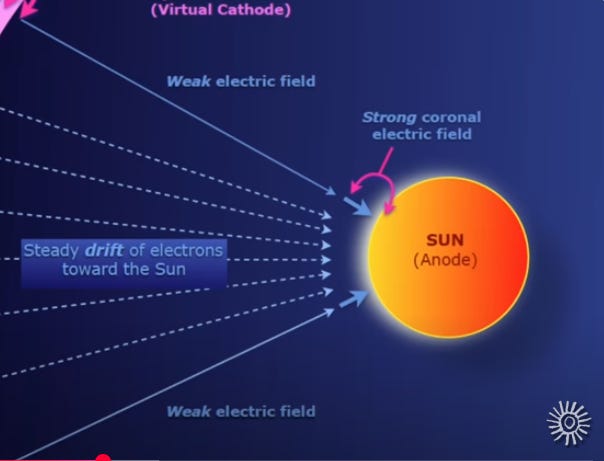
This inward spiralling flow acts as a power source for the sun, with input approximately equalling output. See: https://library-of-atlantis.com/2024/10/13/what-is-the-sun/
There is no slow ‘drift’ of electrons but an organised inward movement of electric field. Electric field movement is concomitant with the existence of a magnetic field at right angles and so the electric field may be deduced from these measurements. There is no need for actual particles in the form of electrons to explain this phenomenon.
As with a wind vortex, a vortex ‘radius’ is formed, where field movement and strength reach a peak and activity is markedly different inside and outside the radius. This can be seen in the chromosphere of the sun where the temperature reaches a peak for no other discernible reason.
Standard models formulate the sun as a nuclear furnace which radiates heat outwards. This should result in a steady decrease of temperature according to an inverse square law when moving away from the sun, but that is not what happens. To explain the chromosphere, think of an inward spiralling energy meeting an outward radiance and creating an stable sphere of dense ‘field energy’.
Observations from plasma physics and weather systems show that more than one ‘radius’ may form within a single vortex.
Coronal discharge
Classical theory surely predicts that discharge from a metal connector (below) will be as a soft blue glow. Electrons should space themselves evenly throughout a conductor, resulting a surrounding field that is static and with a gradient that is uniform or radial according to Coulomb’s law.
Instead we see that discharge is overwhelmingly preferred in very specific spots and that it takes the form of intense conical ‘vortices’ before forming the diffuse blue clouds. The existence of a vortex field is immediately indicated by these structures.
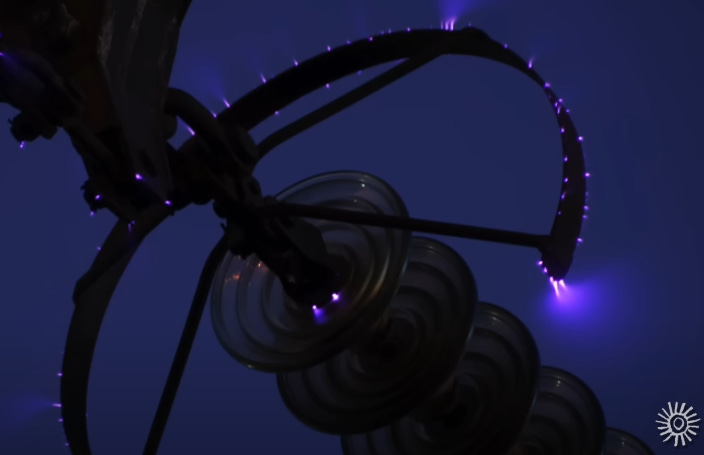
Discharge from the sun, then, can be expected to take on the same general form, with the discharge of field vortices from the most intense areas.
Particles as field vortices
Konstantin Meyl claims the neutrino as an electromagnetic field in the form of a ring vortex which constantly alternates between positive and negative states. See below:
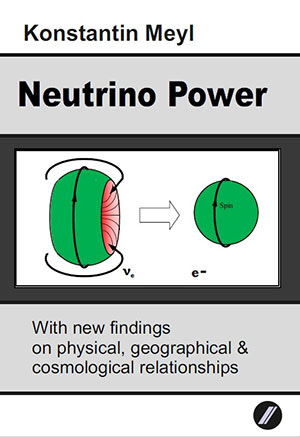
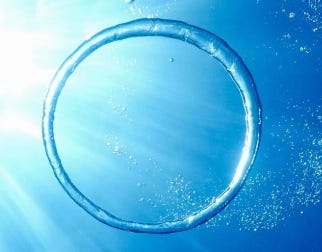
Other ‘particles’ such as photons take on the form of a variety of ring-type vortices and it is helpful to think of water vortices by analogy.
A photon in vortex physics is not a massless particle with no dimensions but an energetic electromagnetic ring vortex which self-propels through the ambient field.
Particles accelerate away from the sun?
"The atmosphere balloons out to 100,000km where it heats up to a million plus degrees. From there, particles accelerate out among the planets in defiance of gravity.”
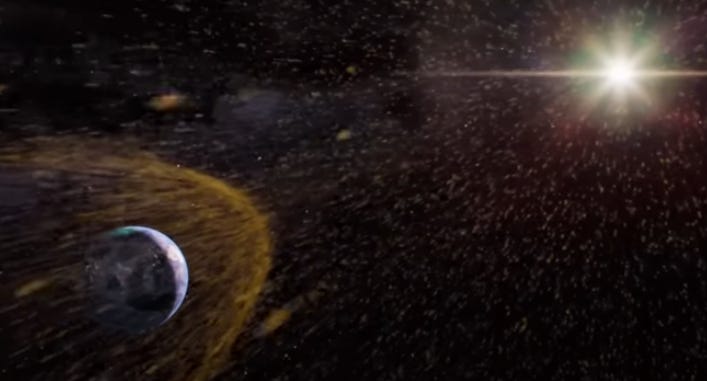
In vortex physics, a particle is usually some form of ring vortex as described above. It has a finite size, intrinsic energy and an electrical polarity. A ring vortex will spin according to its own energy and ‘pull’ itself along by interaction with the ambient field.
In a locally uniform field a photon will propagate at the speed of light in a straight line, but any variation in field strength will necessarily alter the direction and/or speed of such an entity, thereby accounting for ‘gravitational’ lensing i.e. the bending of the path of light near to a star.
In addition to this we have the idea from Meyl that field strength determines ‘distance’ i.e. particle size. This has an explanation now given the nature of a particle as a field vortex; a stronger magnetic-gravitational field intensifies the centripetal forces of a vortex, thereby shrinking the vortex radius which is now synonymous with the perceived particle ‘size’. Conversely, a particle in a weaker field will expand.
Energetic vortices produced by ‘field turbulence’ within the sun will therefore move radially away from the sun at close to the speed of light and as the local field diminishes according to an approximate inverse square law, will consequently expand both their dimensions and propagation ‘speed’.
From the standpoint of a neutral observer, then, the particles are accelerating as they move away from the sun. No additional energy is needed to make this happen; it is an illusion arising from the geometry of space.
From the point of view of the particle itself, however, it maintains its own size and speed as do its companion particles alongside it; they still imagine themselves to be very small! The sun will appear to recede rapidly as it shrinks by coincidence with their moving away from it.
If the particle looks towards Earth, it will see the Earth expand in size in relation to its own distance from the planet but will also see it appear to shrink in relation to its own size as it expands in proportion to the square of its distance from the sun. This sounds like it will initially see an Earth contraction as it expands but later on see an Earth expansion in the final stages of the approach. Confusing.
See: Vortex topology
Comets etc.
Similar considerations should apply to macro sized objects, they should both accelerate and expand when moving away from the sun and both shrink and slow down when moving towards the sun.
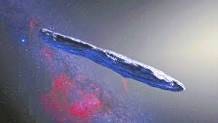
The macro sized ‘interstellar object’ oumuamua is observed to accelerate away from the sun. How?
Why has this not been noticed?
Photons are decreed by theory to move at the (constant) speed of light and to have no physical dimensions which means that nobody is ever going to look for any sort of expansion or acceleration. Moreover, nothing about a photon can be measured at a distance but only under local laboratory conditions, by which time it has adapted to the local field strength.
Similar considerations of measurements apply to all other particles and objects. Actual measurements are always local and any alleged ‘measurement’ of size or speed of distant objects is in fact an inference made from a specific cosmological model which does not take into account the effects of a variable distance metric.
The effect on a planet should be that the side of the planet further away from the sun is that it expands and travels faster than the inner, thereby contributing to a circular or elliptic orbit. This of course happens to be so and as a result, the altered geometry is conflated with the effects of gravitational attraction and again goes unnoticed.
According to Meyl, the Earth adopts a pear shape, with the night time side of the planet expanding slightly owing to the slightly reduced solar field strength. This should result in a slightly longer day than night and this does appear to be the case! Mainstream scientists are not impressed, however, as the effect can also be explained as being caused by refraction of sunlight over the horizon.
The moon landings
Legends abound of the first astronauts on the moon expressing confusion as to the closeness of the horizon the size of craters and the dimensions of the moon as a whole.
What is expected from the above discussion is that the size of the moon as viewed from the space-ship should vary as it is approached but that upon arrival, the astronauts would be larger than on Earth by a factor of sqrt(6), or about 2.5, owing to reduced field strength. The moon should therefore appear correspondingly smaller.
”From this for an astronaut practical consequences result. If he namely would land on Jupiter, he would think flat hills to be gigantic mountains, that small he would be! Vice versa if he landed on the moon, high mountains would appear to be insignificant hills, not because of wrong altitude readings of the terrestrial mission control and measurement centre, but only because of his own body size. The astronauts of the Apollo missions were not prepared for this circumstance and after their landing on the moon were completely surprised, how little validity learned textbook physics has, hardly has one left the earth. They have brought photographs with them which prove the Lorentz contraction to depend on the field and therefore on gravitation.” Konstantin Meyl
”This experience astronaut Roosa made in the Apollo 14 mission. While he alone in his capsule orbited the moon, he depicted mission control, he could see the lunar module and observe his two colleagues at their work on the moon. Nobody wanted to believe the astronaut, since he was flying in a height of 180 km!
“Commander Armstrong (Apollo 11) at the first landing on the moon indicated, the target crater Mackensen, 4.6 km in diameter measured from the earth, just has the size of a soccer field! Astronaut Scott (Apollo 15) called Mount Hardley, which is said to be 4.8 km high, a practice hill for skiing. Perhaps they somewhat have exaggerated, but a true core in the statements always is present!” - Meyl: Scalar waves.. ch 13.5 p.277